
コラム
Dapagliflozin (Forxiga) in Japan: Approved Uses, Directions and Safety
This guide to Dapagliflozin in Japan covers Japanese indications, SGLT2 treatment and off-label weight-management questions. It separates medicine-specific information from the product and prescription checks needed for an individual consultation.
Our clinic does not currently offer prescriptions for this medicine. This article provides general medicine information.
When researching Forxiga (dapagliflozin), distinguish the ingredient, the condition being treated, the formulation and the directions for use. This article explains the uses and safety precautions supported by official documentation. It is not intended for self-diagnosis based only on symptoms or for applying someone else’s prescription or an overseas dosage chart to yourself.
Medical reviewer: Masashi Morita, MD
The approved indications in Japan are type 1 and type 2 diabetes, chronic heart failure receiving standard treatment, and chronic kidney disease excluding end-stage kidney failure and dialysis. These approvals cannot be extended to cosmetic weight loss. This article explains the medicine to help you understand it. Consult a doctor or pharmacist about individual treatment decisions.
- Ingredient
- Dapagliflozin
- Use/patient group
- Diabetes
- Before use
- Product name, strength, medical conditions and other medicines
Summary and quick-reference table
The approved indications in Japan are type 1 and type 2 diabetes, chronic heart failure receiving standard treatment, and chronic kidney disease excluding end-stage kidney failure and dialysis. These approvals cannot be extended to cosmetic weight loss. This article explains the medicine to help you understand it. Consult a doctor or pharmacist about individual treatment decisions.
| What to check | Key points |
|---|---|
| Ingredient/product | Forxiga (dapagliflozin) |
| Scope of the information | Diabetes |
| Individual treatment decisions | Review medical conditions and other medicines with a doctor or pharmacist |
| Deciding whether to use it | Discuss contraindications, other medicines, medical conditions and pregnancy with a doctor or pharmacist |
How the medicine works and its ingredients
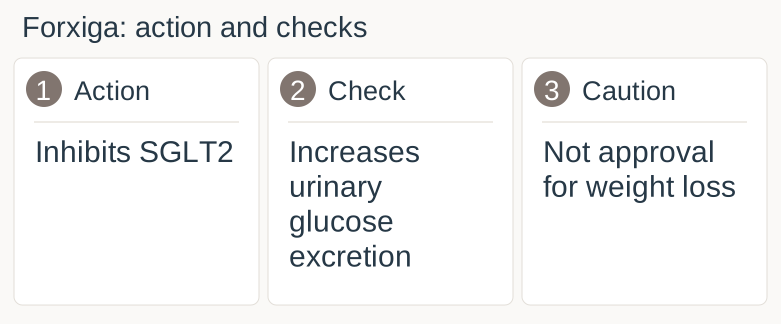
This medicine inhibits SGLT2, which returns glucose to the blood in the kidneys, and increases glucose excretion in urine. Its action depends on kidney function and the medical condition. It does not follow that excreting glucose makes weight loss safe for everyone.
Official prescribing information/product documentation (18. Pharmacology).
Approved uses in Japan and the distinction from off-label use
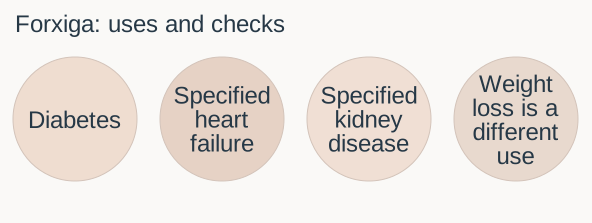
The approved indications in Japan are type 1 and type 2 diabetes, chronic heart failure receiving standard treatment, and chronic kidney disease excluding end-stage kidney failure and dialysis. These approvals cannot be extended to cosmetic weight loss.
Official prescribing information/product documentation (4. Indications, 5. Precautions concerning indications).
Check the formulation and directions for use
Directions differ between diabetes and heart failure or kidney disease. The prescribing information gives a usual starting dose of 5 mg once daily for diabetes and a usual dose of 10 mg once daily for heart failure or kidney disease. For type 1 diabetes it is used with insulin, not as a replacement that allows insulin to be stopped.
Official prescribing information/product documentation (6. Dosage and administration, 7. Precautions concerning dosage and administration).
When treatment may not work well and its limitations
Reduced kidney function may weaken its effect on blood glucose. Deciding to use it for the heart or kidneys differs from assessing its glucose-lowering effect.
Official prescribing information/product documentation (5. Precautions concerning indications, 8. Important precautions).
Reviewing the effect and whether to continue treatment
Blood glucose, HbA1c, kidney function, weight and signs of dehydration or infection are assessed according to the condition. If fever, vomiting or diarrhea prevents you from eating or drinking, check the sick-day instructions you were given and contact your prescriber.
Official prescribing information/product documentation (8. Important precautions).
Side effects and symptoms requiring medical attention
Watch for dehydration, urinary tract or genital infections, hypoglycemia and ketoacidosis. Nausea, abdominal pain, marked fatigue or abnormal breathing require medical assessment even when blood glucose is not high. Also seek advice promptly for fever or genital pain or swelling.
Official prescribing information/product documentation (8. Important precautions, 11. Adverse reactions).
When it cannot be used and conditions to disclose
The prescribing information lists severe ketosis or diabetic coma, severe infection, the periods before and after surgery, serious injury and hypersensitivity to an ingredient as contraindications. Disclose reduced kidney function, older age, dehydration and inability to eat.
Official prescribing information/product documentation (2. Contraindications (patients who must not receive the medicine), 9. Precautions in patients with specific backgrounds).
Other medicines, supplements and everyday precautions
Combining it with insulin or sulfonylureas increases the risk of hypoglycemia. Combining it with diuretics also requires attention to dehydration. Review a complete list of medicines, including other diabetes and blood pressure medicines.
Official prescribing information/product documentation (10. Interactions, 14. Precautions for administration/use).
Pregnancy and breastfeeding precautions
The Japanese prescribing information states that it should not be administered during pregnancy or possible pregnancy. It also advises that breastfeeding is preferably avoided. Discuss treatment and breastfeeding with a doctor.
Storage and maintaining product quality
Store at room temperature according to the instructions on the actual product packaging. Do not take missed doses together; check the directions on your prescription label.
Official prescribing information/product documentation (Storage and shelf life, 14. Precautions for administration/use).
Differences from related medicines
Its ingredient and approved indications differ from those of Canaglu and Lusefi. Forxiga’s heart failure indication must not be applied to every SGLT2 inhibitor.
Official prescribing information/product documentation (4. Indications, 6. Dosage and administration, 18. Pharmacology).
What to discuss with a doctor or pharmacist
Discuss blood glucose, HbA1c, kidney function, current treatment, any history of dehydration or infection, and what to do when you cannot eat. Do not assess treatment solely by weight; also disclose any heart or kidney disease.
This article provides general information about the medicine. Our clinic does not currently offer prescriptions for this medicine. Consult a medical institution that manages the relevant symptoms and indications. If sudden breathing difficulty or altered consciousness occurs, seek emergency care without waiting for an article or an online consultation reply.
Points for safer use
- Confirm the route—oral, topical or injection—and the actual product name and strength.
- Distinguish approval in Japan, off-label use and descriptions in overseas documentation.
- Record benefits and side effects together; do not increase the dose yourself or share medicines.
- Tell a healthcare professional about other medicines, supplements, pregnancy, breastfeeding and medical conditions.
Frequently asked questions
For Dapagliflozin, can I use it for weight loss if I do not have diabetes?
Weight loss for cosmetic purposes is separate from the approved Japanese indications described here. Weight change alone cannot establish safety or benefit; a medical assessment must consider risks such as dehydration and ketoacidosis.
How does Dapagliflozin differ from other medicines or products?
Its ingredient and approved indications differ from those of Canaglu and Lusefi. Forxiga’s heart failure indication must not be applied to every SGLT2 inhibitor.
Can SWIFT prescribe Dapagliflozin through an online consultation in Japan?
Our clinic does not currently offer prescriptions for this medicine. Discuss its use with the prescribing clinician or an appropriate medical specialty.
Medical reviewer of this article
Dr Masashi Morita
Medical reviewer, Shimbashi Ginza Swift Clinic
- Board-certified specialist and instructor, Japanese Urological Association
- Board-certified specialist, Japan Endocrine Society
- Doctor of Medical Science, Showa University
- Graduate of Showa University School of Medicine
References
- PMDA electronic label (source checked 2026-10-13; primary sources rechecked 2026-10-29)