
Articles
Doxy-PEP in Japan: STI Prevention, Timing and Prescription Checks
This guide to Doxy-PEP in Japan covers STI prevention evidence, timing, resistance and testing. It separates medicine-specific information from the product and prescription checks needed for an individual consultation.
Doxy-PEP is a prevention approach that involves taking the antibiotic doxycycline after sex to reduce the risk of some bacterial sexually transmitted infections (STIs). It does not prevent all infections. The expected benefits and the strength of the evidence differ by population and infection.
If you are researching Doxy-PEP in Japan, this article explains its mechanism, research findings, timing and dosing, side effects, antibiotic resistance and the need for testing. For our consultation options and fees, see Doxy-PEP online consultations and prescription fees.
Medical reviewer: Masashi Morita, MD
Doxy-PEP involves taking doxycycline after sex to reduce the risk of some bacterial sexually transmitted infections. Its use for prevention is off-label in Japan, and the evidence and benefits are not the same for every person or infection. Discuss eligibility and dosing with a doctor and combine it with testing.
- Name
- Doxy-PEP
- Active ingredient
- Doxycycline
- Main infections considered
- Bacterial STIs such as syphilis and chlamydia
- Timing
- As soon as possible after sex, no later than 72 hours
- Status in Japan
- Off-label use for STI prevention
- Also needed
- Eligibility and medication review, and regular STI testing
Doxy-PEP: the ingredient and how it works
“Doxy” refers to doxycycline; “PEP” means post-exposure prophylaxis. Doxycycline is a tetracycline antibiotic that interferes with the protein synthesis bacteria need to multiply. Vibramycin is a prescription medicine containing this ingredient. PMDA prescribing information, sections 3 and 18
Even when the same medicine is used to treat infections, treatment after an infection and prevention after sex are different uses. Do not use a preventive dose as a substitute for treatment after an infection has been diagnosed.
How has its preventive benefit been studied?
The US CDC's 2024 guideline summarises several comparative trials. It reports that doxycycline 200 mg within 72 hours after sex reduced syphilis and chlamydia incidence by more than 70%, and gonorrhoea by about 50%. These are relative reductions in the populations studied, not a claim that “70% of people who take it will not become infected.” CDC guideline
The principal evidence comes from trials mainly involving men who have sex with men (MSM) and transgender women. Participants' circumstances and local antibiotic resistance patterns cannot simply be applied to every patient.
The benefit against gonorrhoea also depends on local resistance
Bacteria that are less susceptible to an antibiotic are called resistant bacteria. Gonococcal susceptibility to doxycycline varies by region, so figures from overseas trials may not be reproduced in Japan. Do not assume that Doxy-PEP prevents syphilis, chlamydia and gonorrhoea to the same extent. CDC guideline
Who may consider it, and how does the evidence differ by sex and gender?
The CDC recommends offering Doxy-PEP, after discussing benefits and risks, to MSM and transgender women who have been diagnosed with syphilis, chlamydia or gonorrhoea in the previous 12 months. This is the population covered by a US guideline, not our clinic's prescribing criteria. CDC guideline: recommended population
For cisgender women, cisgender heterosexual men, transgender men and some other populations, the CDC does not make a general recommendation because the evidence is insufficient. A trial in women did not show a significant benefit, but this does not establish that it is ineffective for all women. The study population and medication adherence, among other conditions, must be considered.
Occupation or gender alone does not mean that someone definitely needs it or will receive the same benefit. Tell the doctor about sexual exposures, previous STIs, test results and medicines you take.
Infections it does not prevent, and what to do if you have symptoms
Doxy-PEP does not prevent viral infections such as HIV, genital herpes or HPV. It is not contraception. Because protection is incomplete, it needs to be combined with testing and other prevention methods such as condoms. CDC guideline: comprehensive prevention
If you notice possible STI symptoms, such as pain when urinating, discharge, genital ulcers or a rash, seek examination and testing rather than taking more preventive medicine and waiting. A confirmed infection requires treatment appropriate to that infection.
When it is taken and how to interpret dosing information
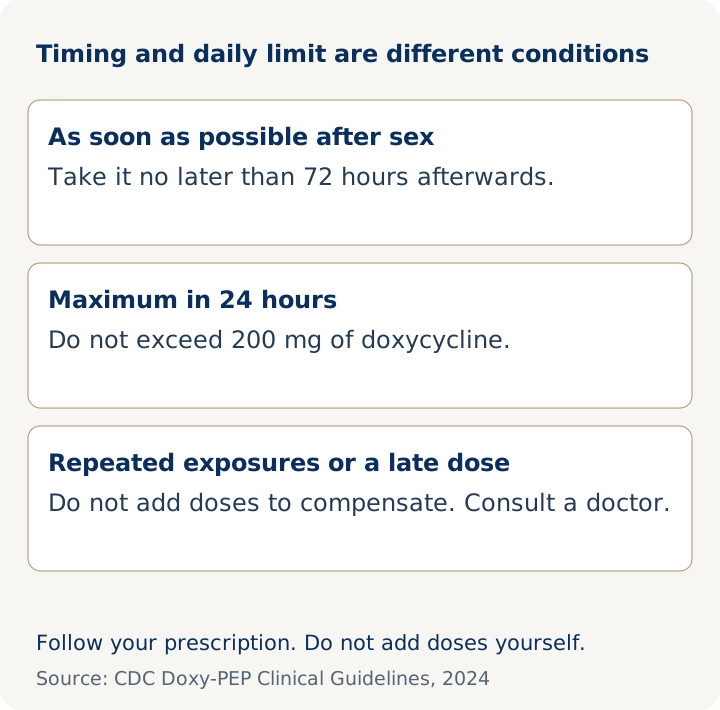
The CDC's Doxy-PEP regimen is doxycycline 200 mg as soon as possible after sex, no later than 72 hours, with no more than 200 mg in 24 hours. This describes the conditions underlying the evidence on benefit and safety; it is not a way to determine the strength or tablet count of your own prescription. Check your dispensing instructions and the doctor's directions. CDC guideline: dosing
Repeated sexual exposures or more than 72 hours after sex
Do not repeatedly add 200 mg for each sexual encounter on the same day. Tell the doctor when you last took a dose and when sex occurred, and confirm how to stay within the 24-hour maximum. There is no evidence that taking more compensates for being beyond 72 hours. Discuss testing or other options rather than increasing the dose yourself.
This is different from taking medicine before sex
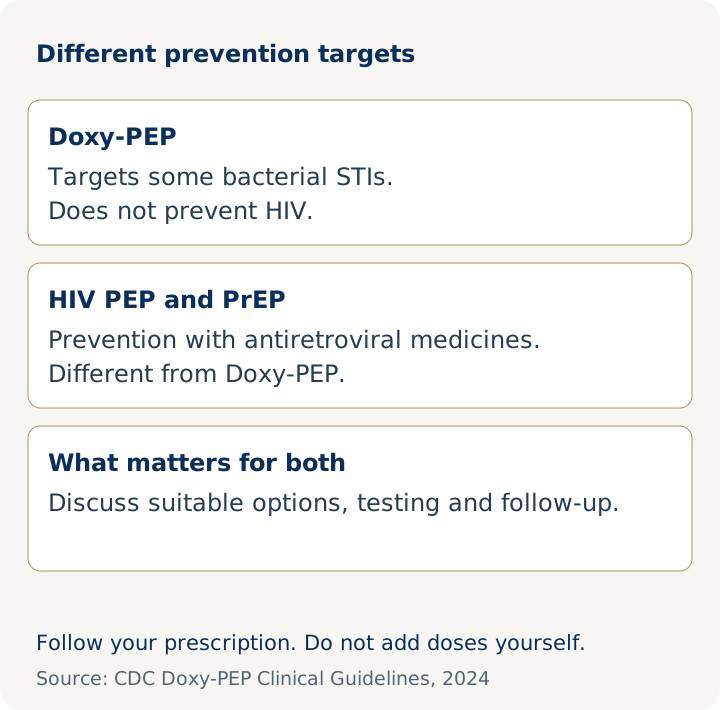
The Doxy-PEP discussed here is prevention after sex. It is not the same approach as Doxy-PrEP, which uses doxycycline in advance, and it uses a different medicine from HIV PrEP. Do not bring the dose forward or switch to daily dosing in an attempt to improve protection. CDC guideline
Take it with water and do not lie down afterwards
If the medicine stays in the oesophagus, it may cause oesophagitis or an oesophageal ulcer. Take it with plenty of water and avoid taking it immediately before bed. The CDC's Doxy-PEP counselling advice is to take it with food and sufficient water, and not to lie down for one hour afterwards. PMDA prescribing information, sections 14 and 15 / CDC guideline: dosing advice
Side effects and precautions in sunlight
Possible side effects include nausea, vomiting, loss of appetite, abdominal pain, diarrhoea and rash. Difficulty swallowing or pain deep in the chest after a dose also needs attention. PMDA prescribing information, sections 11 and 14
Photosensitivity, in which skin becomes more sensitive to sunlight, has also been reported. Avoid strong sunlight during use and protect your skin with clothing and other measures. Do not assume antibiotics have almost no side effects; report changes in your health to the prescriber. PMDA prescribing information, section 11 / CDC guideline
Symptoms that require stopping the medicine and urgent care
Breathing difficulty or swelling of the face or throat may indicate a severe allergic reaction, including anaphylaxis. Stop taking the medicine and seek emergency care immediately, without waiting for a routine appointment.
Also watch for a widespread rash with fever, skin or mucosal erosion, blood in stools, frequent diarrhoea or severe abdominal pain, or yellow skin or eyes. The prescribing information lists serious skin reactions, colitis and liver injury. Do not take another dose; promptly consult a medical provider. PMDA prescribing information, section 11.1
Why other medicines and supplements must be checked
People with a history of allergy to tetracycline antibiotics must not use it. Tell the doctor about swallowing disorders, liver disease and other relevant conditions. PMDA prescribing information, sections 2 and 9
Products containing calcium, magnesium, aluminium or iron can reduce absorption. Antacids and supplements must also be reviewed. The CDC's Doxy-PEP advice recommends at least two hours between the dose and dairy products, antacids or supplements containing these minerals. The Japanese prescribing information describes the effects of food or milk on absorption differently, so confirm your own instructions with the pharmacist or doctor. PMDA prescribing information, sections 10, 15 and 16 / CDC guideline
Warfarin, some antiepileptic medicines, diabetes medicines and oral contraceptives also have interaction precautions. Provide a full list of prescription medicines, non-prescription medicines and supplements rather than deciding which names to omit. Avoid combining leftover antibiotics on your own.
Pregnancy and breastfeeding
The Japanese prescribing information restricts use in pregnancy or possible pregnancy to cases where the treatment benefit outweighs the risk. Effects on fetal bones and teeth require attention in the latter half of pregnancy. It states that avoiding breastfeeding is preferable because the medicine passes into breast milk. PMDA prescribing information, sections 9.5 and 9.6
Our existing clinic guidance tells pregnant or breastfeeding patients not to take it. If pregnancy is possible, do not use it for prevention on your own; discuss this during the consultation. Our Doxy-PEP information
Antibiotic resistance and reviewing continued use
Repeated antibiotic use affects not only the target pathogens but also bacteria normally present in the body. With Doxy-PEP, selection of resistant bacteria and long-term effects on gut bacteria and other organisms remain concerns. The CDC advises discussing short-term benefits alongside long-term risks that are not yet fully understood. CDC guideline: resistance and long-term effects
Do not take it daily on your own or give your prescription to someone else. Review the need for it regularly with the doctor, considering whether benefit is expected in your circumstances, whether ongoing testing is possible and whether side effects have occurred.
STI testing and follow-up are still needed afterwards
Taking a preventive medicine does not confirm that you are free of infection. The CDC recommends testing for syphilis, chlamydia, gonorrhoea and other relevant infections at the start and every three to six months afterwards, according to the sites exposed during sex, while reviewing the need to continue. HIV testing also depends on HIV status and PrEP use. CDC guideline: follow-up
This does not mean waiting three to six months if you have symptoms. Seek care earlier if symptoms occur. Testing immediately after sex may not detect an infection, so confirm the tests needed and when to repeat them during your visit. See also our STI consultations and testing.
How it differs from HIV PEP and PrEP
| Method | Main prevention target | Approach |
|---|---|---|
| Doxy-PEP | Some bacterial STIs | Doxycycline after sex |
| HIV PEP | HIV | Urgent prevention using antiretroviral medicines after HIV exposure |
| HIV PrEP | HIV | Prevention using antiretroviral medicines before exposure |
Although both use the term “PEP”, the medicines and prevention targets differ. Taking Doxy-PEP does not address possible HIV exposure. If you are concerned about HIV exposure, contact a medical provider immediately rather than waiting for a Doxy-PEP appointment or delivery. CDC guideline: HIV prevention alongside Doxy-PEP
Storage and checking the condition of the medicine
Vibramycin tablets are stored at room temperature. Follow the storage conditions and expiry information on the dispensing label or packaging. Remove tablets from the PTP blister sheet when you take them. PMDA prescribing information: storage and section 14
Do not use medicine on your own if you cannot verify its condition, for example if the packaging is damaged or you do not know when it was prescribed or when it expires. Ask the dispensing clinic or pharmacist if you are concerned about its quality.
Approval in Japan and off-label use
Vibramycin is an antibiotic approved in Japan. However, treatment of the infections listed in its prescribing information is distinct from prevention of STIs through Doxy-PEP. Prevention after sex is outside the approved indications and dosing. PMDA prescribing information, sections 4 and 6
A recommendation in an overseas guideline does not constitute Japanese approval or establish appropriate prescribing for everyone. The consultation considers expected benefits, side effects, resistance and testing requirements before a decision on use.
Consulting our clinic
Swift Clinic provides Doxy-PEP consultations. The existing listed medicine fees are ¥1,500 for one dose and ¥8,900 for ten doses. Consultation fees have an exception based on the number of tablets prescribed at the first visit, so do not treat the medicine price alone as the total cost. Confirm costs including consultation and collection arrangements.
Our fees, consultation process and collection arrangements are summarised under Doxy-PEP online consultations and prescription fees. Tell the doctor the time since sex, symptoms, medical history and medicines you take, and discuss whether a prescription is appropriate.
Points for safer use
- Understand the populations studied and the limitations, and discuss whether it is suitable for you.
- Follow the prescribed timing and dose; do not add or increase doses yourself.
- Disclose allergies, other medicines, pregnancy or breastfeeding and changes in health.
- Stop additional doses if side effects are suspected; seek urgent care for serious symptoms.
- Do not rely on preventive medicine alone: continue STI testing and review whether use remains necessary.
Frequently asked questions
Does Doxy-PEP completely prevent STIs?
No. Infection can still occur even with the bacterial STIs it targets, and viral infections such as HIV are not covered. Combine it with testing and other prevention methods.
For Doxy-PEP, does it work equally well for women and men?
The same benefit cannot be assumed. Most research involves MSM and transgender women; evidence of effectiveness is insufficient for cisgender women and some other populations. Discuss benefits and risks with the doctor rather than deciding based on gender alone.
For Doxy-PEP, should I take more if more than 72 hours have passed?
Do not increase the dose yourself. There is no evidence that taking more compensates for being outside the studied 72-hour window. Explain how much time has passed and discuss testing or other options.
For Doxy-PEP, should I take it after every encounter when sexual activity continues?
Do not add doses according to the number of encounters. The CDC regimen must not exceed 200 mg in 24 hours. Confirm the prescriber's instructions, including when you took the previous dose.
Do I need testing after Doxy-PEP?
Yes. Protection is incomplete and some infections cause no symptoms. Combine baseline and regular testing with a review of the need to continue. If symptoms develop, consult a provider without waiting for the scheduled test.
For Doxy-PEP, is it the same medicine as HIV PEP?
No. Doxy-PEP uses an antibiotic to prevent some bacterial STIs; HIV PEP uses antiretroviral medicines. Do not rely on Doxy-PEP alone when concerned about HIV exposure.
Medical reviewer of this article
Dr Masashi Morita
Medical reviewer, Shimbashi Ginza Swift Clinic
- Board-certified specialist and instructor, Japanese Urological Association
- Board-certified specialist, Japan Endocrine Society
- Doctor of Medical Science, Showa University
- Graduate of Showa University School of Medicine