
コラム
Minoxidil in Japan: Topical vs Oral Products, Costs and Safety
This guide to Minoxidil in Japan covers topical versus oral treatment, Japanese approval and safety. It separates medicine-specific information from the product and prescription checks needed for an individual consultation.
This page explains how Minoxidil works, its directions, limitations and safety. For prices and individual prescriptions, see SWIFT’s relevant care information.
Minoxidil is an ingredient used for hair growth, but topical and oral use are separate treatments. Minoxidil hair-growth medicines approved in Japan are topical formulations; oral minoxidil is unapproved in Japan. Selection must consider effects on the heart and blood pressure as well as efficacy.
Medical reviewer: Masashi Morita, MD
Minoxidil is an ingredient used for hair growth, but topical and oral use are separate treatments. Minoxidil hair-growth medicines approved in Japan are topical formulations; oral minoxidil is unapproved in Japan. Selection must consider effects on the heart and blood pressure as well as efficacy.
- Ingredient/class
- Minoxidil
- Eligible patients/indications
- Approved topical products are used for androgenetic alopecia. Sudden shedding, patchy loss or scalp inflammation requires investigation of other causes. The Japanese Dermatological Association’s 2017 guideline recommends topical use and states that oral use should not be performed. Clinic services and professional-society recommendations need separate explanation.
- Assessing effects
- Hair growth cannot be judged within a few days. Follow the topical product instructions and monitor with photographs and scalp findings. Increased shedding early on is not automatically normal; seek advice if it is persistent or marked.
- Clinic care
- Service information supported by public sources is identified in the article. Final prescribing decisions are made during consultation.
What the medicine is
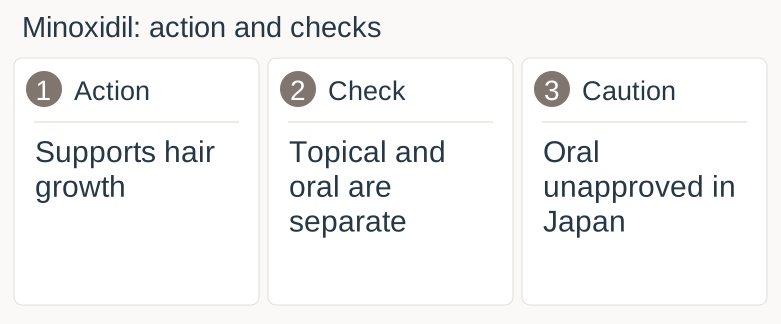
This ingredient supports hair growth through actions on dermal papilla cells and other mechanisms. It does not resolve every cause of hair loss, and differs from finasteride, which suppresses progression associated with male hormones.
Eligible patients and approved indications
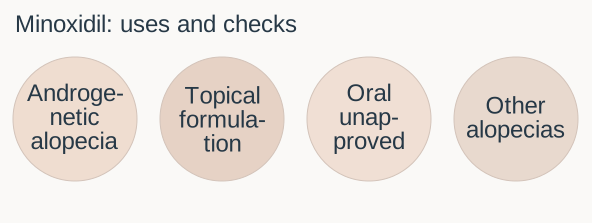
Approved topical products are used for androgenetic alopecia. Sudden shedding, patchy loss or scalp inflammation requires investigation of other causes. The Japanese Dermatological Association’s 2017 guideline recommends topical use and states that oral use should not be performed. Clinic services and professional-society recommendations need separate explanation.
Source: Medicine-specific primary documentation. The product used by the clinic is not assumed to be identical to the formulation in this documentation.
Treatment limitations and when diagnosis is needed
Topical treatment may not produce sufficient change; increasing the amount or frequency does not establish a safe increase in benefit. Oral treatment cannot be guaranteed to work better than topical treatment. Do not directly apply it to scarring alopecia or alopecia areata.
Formulations and basic directions
For topical use, check the product’s concentration, eligible patients, amount and frequency before applying it to the scalp. Oral minoxidil has no approved dose for hair-loss treatment in Japan; do not repurpose topical instructions or overseas hypertension doses. If choosing SWIFT’s oral combination, receive a safety explanation for each ingredient.
Source: Medicine-specific primary documentation. The product used by the clinic is not assumed to be identical to the formulation in this documentation.
Timing of response and decisions about continuation
Hair growth cannot be judged within a few days. Follow the topical product instructions and monitor with photographs and scalp findings. Increased shedding early on is not automatically normal; seek advice if it is persistent or marked.
Side effects and symptoms to watch for
With topical use, watch for itching, redness and dermatitis. Oral use raises concerns including excessive hair growth, edema, palpitations and blood pressure effects. Do not combine topical and oral adverse-reaction frequencies or explain oral safety solely through topical approval.
Source: Medicine-specific primary documentation. The product used by the clinic is not assumed to be identical to the formulation in this documentation.
When to stop and seek medical attention
Stop use and seek medical attention promptly for chest pain, breathing difficulty, fainting, sudden weight gain or pronounced edema. Also seek advice for severe scalp inflammation rather than applying more.
Restrictions and interactions
Disclose heart or kidney disease, abnormal blood pressure and antihypertensive use. Topical products also have age, sex and scalp-condition restrictions. For oral products, check effects with other cardiovascular medicines and separately check contraindications for ingredients such as finasteride in combination tablets.
Source: Medicine-specific primary documentation. The product used by the clinic is not assumed to be identical to the formulation in this documentation.
Pregnancy, breastfeeding and patient precautions
Approved Japanese topical minoxidil products for women include products that must not be used during pregnancy, possible pregnancy or breastfeeding. Check the actual product instructions and consult a doctor or pharmacist without using it. Finasteride-containing tablets intended for men must not be repurposed for women.
Additional care
Avoid vigorous scalp rubbing and self-combination of several hair-growth products. Sleep and diet alone do not replace AGA treatment, but sudden shedding warrants assessment of health, nutrition and other diseases.
Storage and quality checks
For topical products, check label instructions about fire and temperature. Store oral products according to the clinic product’s label; do not provide identical storage directions for both.
Differences from other medicines and treatments
Finasteride and dutasteride suppress DHT production to treat male AGA and have a different role from minoxidil. Combination products do not make approval status or risks identical for every ingredient.
Buying minoxidil in Japan: topical products and tablets are different decisions
If you searched for minoxidil 5% in Japan, check whether you are viewing a topical product rather than tablets. A percentage on a topical label is not an oral dose, and a combination tablet may include other hair-loss medicines. The approval and safety distinctions are explained above.
For topical treatment, ask about the concentration, container size and intended users. For tablets, ask about every ingredient and the prescribed dose. SWIFT’s English care page provides the consultation route and published charges, but a price alone does not identify the product. Confirm current supply and any consultation or delivery costs before proceeding.
Discussing consultation and prescribing with SWIFT
SWIFT’s official AGA page lists topical minoxidil at JPY 6,000 and combination products including finasteride-containing Hair Revival and dutasteride-containing Hair Revival-d. It explicitly states that oral minoxidil is unapproved in Japan. Check the latest conditions for each product, including topical concentration and volume, combination-product approval status, sourcing and prices. Oral minoxidil is unapproved in Japan. The clinic states that this treatment is self-funded and outside Japan’s Adverse Drug Reaction Relief System. Confirm the actual product, sourcing, approval status and costs.
Frequently asked questions
For Minoxidil, are oral and topical treatment the same?
No. Japanese approval, recommendations, directions and side effects differ. When comparing costs, check the concentration or strength, volume or quantity and all ingredients separately for each dosage form.
For Minoxidil, can women use it?
Topical products for women exist, but oral combinations intended for men must not be repurposed. Diagnosis and formulation checks are necessary.
For Minoxidil, can I continue if shedding increases?
It may be an early change, but marked or prolonged shedding, or shedding with health abnormalities, requires assessment during consultation.
Medical supervision
Dr Masashi Morita (Board-certified specialist and supervising physician, Japanese Urological Association / Board-certified specialist, Japan Endocrine Society / Doctor of Medical Science).