
コラム
Hydroquinone Cream in Japan: Uses, Safety and Treatment Options
This guide to Hydroquinone cream in Japan covers pigmentation-treatment limits, application, storage and irritation. It separates medicine-specific information from the product and prescription checks needed for an individual consultation.
If you are researching hydroquinone cream in Japan, this article explains its role in pigmentation treatment, directions, side effects and storage. The clinic-prescribed preparation and treatment checks are described below. For prices and care procedures, see hydroquinone online care and prescription prices.
This topical ingredient has long been used to treat dark spots and pigmentation. Rather than whitening skin generally, it suppresses excess melanin production and gradually makes pigmentation less noticeable. Some spots respond poorly; understand use and storage as well.
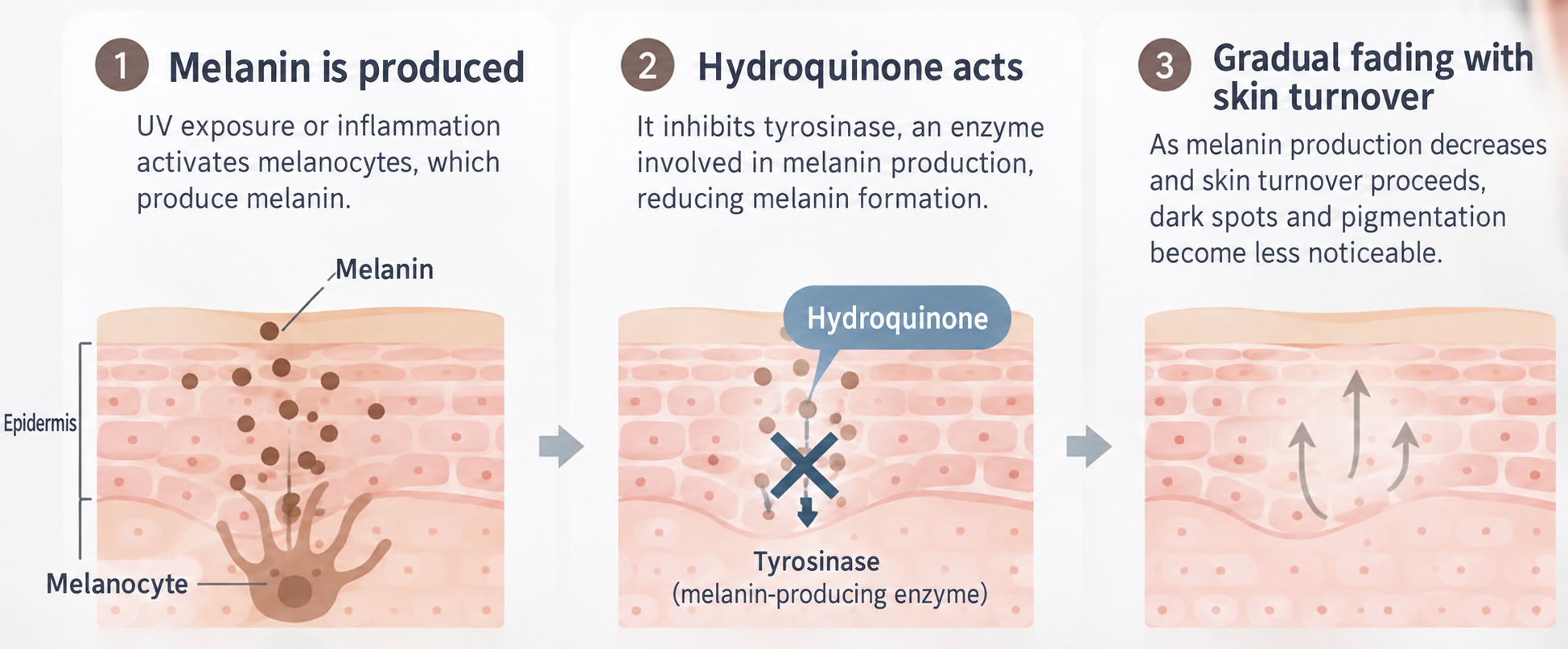
Hydroquinone inhibits tyrosinase, an enzyme involved in melanin production. It does not immediately erase existing spots, but reduces new melanin production and allows fading with skin turnover. Response and assessment timing depend on pigmentation type, preparation and skin reaction. Review progress with the doctor; do not extend use on your own when little change is seen. Continue sun protection. Effects vary between individuals.
Medical reviewer: Masashi Morita, MD
**Hydroquinone inhibits tyrosinase, an enzyme involved in melanin production.** It does not immediately erase existing spots, but reduces new melanin production and allows fading with skin turnover. Response and assessment timing depend on pigmentation type, preparation and skin reaction. Review progress with the doctor; do not extend use on your own when little change is seen. Continue sun protection. Effects vary between individuals.
- Ingredient
- Hydroquinone
- Dosage form
- Topical
- Main role
- Suppression of melanin production
- Checks needed
- Pigmentation type, concentration, duration and skin response
- Clinic publicly listed formulation
- 5%, 5 g (confirm current availability during consultation)
What hydroquinone is
Hydroquinone is a topical ingredient long used for dark spots and pigmentation. It is not a medicine for whitening skin generally; it suppresses excess melanin production and gradually makes pigmentation less noticeable.
Melanin is made by cells called melanocytes. Stimuli such as ultraviolet exposure or inflammation increase production; accumulated pigment becomes visible as dark spots or pigmentation. Tyrosinase is an important enzyme in this process.
Hydroquinone interferes with tyrosinase and suppresses melanin production. Rather than immediately removing existing spots, it reduces production of new melanin and allows fading through skin turnover.
What kinds of pigmentation it is used for
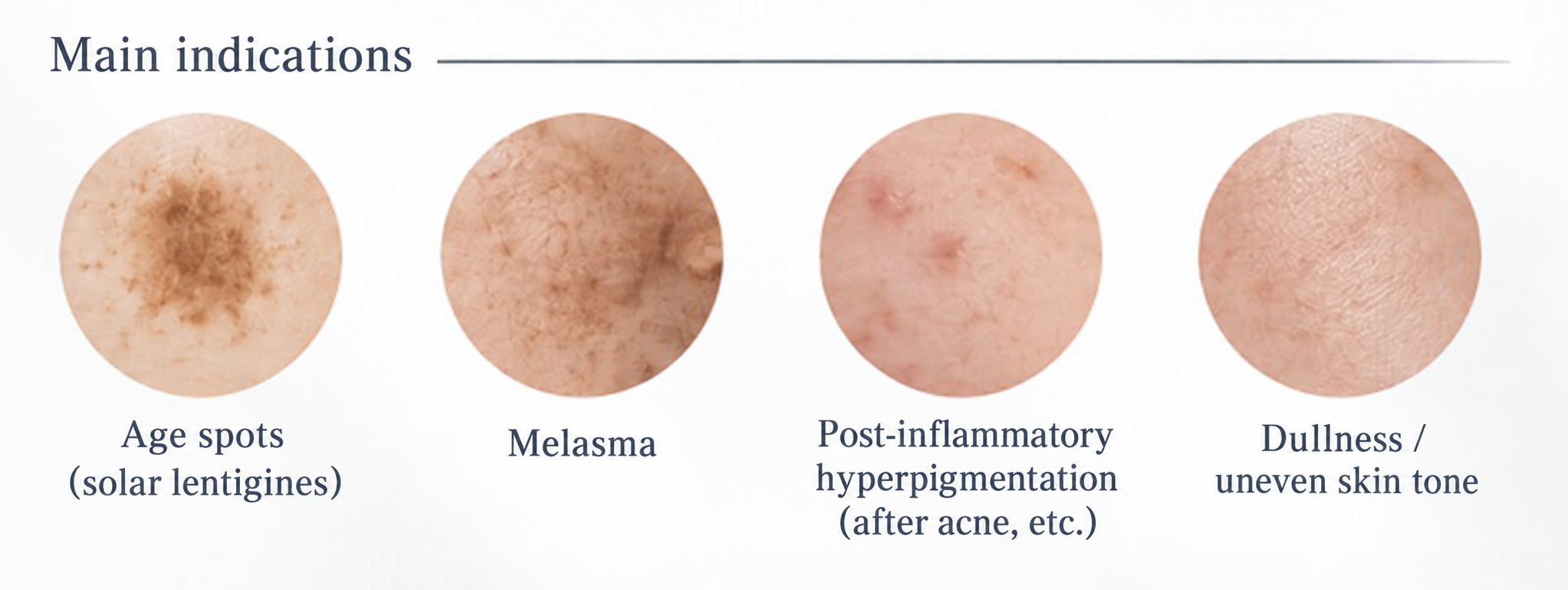
Hydroquinone is mainly used for pigmentation from melanin in the epidermis.
| Pigmentation type | Description | Features |
|---|---|---|
| Age spots | Relatively well-defined brown patches associated with years of ultraviolet exposure | Common on cheeks, temples and backs of hands; laser treatment may suit some types |
| Melasma | Symmetrical light-brown patches around the cheekbones | Hormones, inflammation and friction as well as ultraviolet exposure may contribute; treatment planning differs from other spots |
| Post-inflammatory pigmentation | Brown color after acne, eczema, burns or laser treatment | Excess melanin remaining after inflammation; brown acne marks may be this type |
Some spots respond poorly
Not every brown lesion fades with hydroquinone. When melanin lies deep in the dermis, topical treatment alone may not produce sufficient change.
| Pigmentation type | Melanin location | Role of topical treatment |
|---|---|---|
| Age spots | Mainly epidermis | Often a topical-treatment target |
| Melasma | Mainly epidermis | Sun protection and reduced friction matter alongside topical treatment |
| Post-inflammatory pigmentation | Epidermis to dermis | Epidermal pigment is more likely to be a topical-treatment target |
| Freckles | Epidermis | Constitutional factors are important; topical change may be limited |
| ADM (acquired dermal melanocytosis) | Dermis | Difficult to reach with topical treatment alone |
| Nevus of Ota | Dermis | Difficult to reach with topical treatment alone |
These can look similar but require different treatments. Diagnose the type of pigmentation before using hydroquinone. Several types can also coexist.
Does a higher concentration work better?
Directions and precautions vary with concentration and application area. A particular trial’s improvement rate cannot directly predict your own result.
Higher concentration is not necessarily better. Greater concentration increases melanin-suppressing action but also tends to increase irritation. Suitable concentration depends on skin type, pigmentation type, application area and other treatments.
| Concentration | Context |
|---|---|
| Varies by product | Check ingredients, concentration and conditions separately for cosmetics and medical preparations |
| 4% | Widely used in clinical research |
| Above 4% | Reports of exogenous ochronosis often involve concentrations above 4% or prolonged use |
The clinic preparation is 5%
The clinic prescribes 5% hydroquinone, within the above-4% category. It is therefore used under a doctor’s management with defined periods and monitoring. The clinic advises using within approximately 3 months after opening and avoiding prolonged continuous use.
Avoid prolonged self-directed use of high-concentration preparations.
Basic directions
Follow the prescriber because use varies with concentration and prescription. It is generally used in nighttime skin care after washing and preparing the skin, applied thinly as the final step.
More product does not increase benefit proportionally. It instead makes irritant dermatitis more likely.
Apply only to spots or over a wider area?
This depends on treatment purpose. Well-defined lesions may receive focused application, while broader uneven pigmentation such as melasma or post-inflammatory pigmentation may warrant a wider area at the doctor’s discretion. Do not spread onto normal skin yourself; confirm the application area when prescribed.
Clinic frequency, duration and application details are on the hydroquinone online consultation and prescribing page.
Consider sunscreen alongside treatment
Ultraviolet exposure causes melanocytes to produce melanin again. Continued daytime exposure may make changes less noticeable despite suppression by hydroquinone. Clinical trials evaluating hydroquinone also used sunscreen alongside treatment.
In addition to the SPF number, follow these measures.
• Apply enough • Reapply during prolonged outdoor time • Use a hat or parasol • Avoid prolonged strong sunlight
How long until changes become noticeable?
Response and assessment timing depend on pigmentation type, preparation and skin reaction. Review progress with the doctor; do not extend use on your own when little change is seen.
If there is no change after a period of use
Rather than continuing indefinitely, the following may need review.
• Whether hydroquinone suits the pigmentation • Whether pigment is deep • Whether melasma and other spots coexist • Whether ultraviolet exposure or friction continues
Side effects and precautions
| Symptom | How it occurs | Response |
|---|---|---|
| Redness, itching or stinging | Relatively common; peeling or swelling may occur | Mild symptoms may allow frequency adjustment; stop and seek advice if severe |
| White patches or pigment loss | Pigment loss has been reported. Low concentration or the absence of redness does not by itself establish safety. WHO/IPCS source (1994) | Stop use and consult a doctor if the skin becomes abnormally pale or otherwise changes. Seek advice for gray or blue-black changes as well. |
| Exogenous ochronosis | Prolonged-use sites become gray to blue-black | Difficult to treat once present; do not use for years on your own initiative |
Irritation is not proof of efficacy that must be tolerated. Stop and seek advice for severe symptoms.
About exogenous ochronosis
Exogenous ochronosis is a particular long-term concern. A systematic review of reported cases found a median use duration of 5 years, with many reports involving concentrations above 4%.
If you have continuously used an old prescription, discuss it with a doctor.
Symptoms requiring stopping and contacting the clinic
Stop temporarily and seek advice for these symptoms
-
Persistent severe redness
-
Severe itching or swelling
-
Blisters
-
Pain
-
Abnormally pale skin limited to the application site
-
Gray to blue-black discoloration
-
Clearly darker pigmentation
-
Marked cream discoloration or changes in smell, firmness, separation or other condition
Continuing despite symptoms is not recommended. After assessing the skin, decisions may include frequency adjustment, discontinuation or another treatment.
Use during pregnancy or breastfeeding
At SWIFT, hydroquinone is not prescribed during pregnancy or breastfeeding. Please tell the doctor if you are pregnant or breastfeeding.
Pigmentation such as melasma can become more noticeable during pregnancy. One option is focusing on sun protection and reconsidering treatment after childbirth.
Storage
Hydroquinone quality readily changes with storage conditions. Handle it carefully.
• Avoid direct sunlight (including bathroom windowsills or cars) • Avoid heat (summer rooms and cars can become very hot) • Close immediately after use to reduce air exposure • Do not transfer containers, which are designed for light protection and sealing
Whether refrigeration is needed depends on the preparation
Not every hydroquinone product must be refrigerated. Suitable storage depends on the base and other ingredients; prioritize instructions for the preparation prescribed to you.
The clinic preparation is refrigerated and protected from light, and should be used within approximately 3 months after opening.
Hydroquinone oxidizes and changes color
The clinic often receives questions about whether a changed cream color is acceptable.
Hydroquinone is chemically prone to oxidation. Prolonged storage or exposure to air, light and temperature may gradually turn cream from yellow to brown.
This does not necessarily mean the patient handled it carelessly. The ingredient itself is vulnerable to oxidation. Bases, antioxidants and containers help, but cannot eliminate oxidation entirely.
Can a discolored preparation be used?
For clearly changed color or condition, do not continue on your own initiative; contact the prescribing institution.
Applying brown hydroquinone does not simply mean the brown cream itself creates a dark spot. However, marked discoloration signals oxidation or deterioration. Active-ingredient stability and quality can no longer be guaranteed, so continued use is not recommended.
If the clinic preparation clearly changes color or properties, do not use it as is; contact the clinic.
Differences from tretinoin and combined use
| Hydroquinone | Tretinoin | |
|---|---|---|
| Main role | Suppresses melanin production | Promotes epidermal turnover |
| Direction of action | Reduces new pigment formation | Helps remove existing pigment |
| Main side effects | Redness, dermatitis and pigment abnormalities | Redness, peeling, dryness and irritation |
Combining them addresses pigmentation through reducing new melanin production and removing existing melanin. Combined treatment has a long history of use.
Tretinoin tends to cause more skin irritation than hydroquinone, including redness, peeling, stinging and dryness. Severe inflammation may instead cause post-inflammatory pigmentation. A doctor should guide amount and frequency.
At SWIFT, when these creams are used together, tretinoin is applied first. Follow the doctor’s instructions for the amount and frequency.
For tretinoin, see the tretinoin online consultation and prescribing page.
Can it be combined with laser treatment?
Combination may be appropriate depending on the condition, but laser plus hydroquinone is not an automatic choice for every dark spot.
Melasma can worsen with irritation, requiring careful choice of laser type, settings and technique. For age spots and other lesions, topical treatment may be combined to address post-inflammatory pigmentation after laser pigment removal.
The best approach depends on pigmentation type. See the laser dark-spot treatment page.
Obtaining a prescription at the clinic
The clinic prescribes hydroquinone 5% (5 g) at JPY 2,980 per container. The consultation fee is JPY 0 when prescribed; online care adds only JPY 550 shipping. A tretinoin set is also available.
Online care is available from the initial consultation, with delivery throughout Japan. For prices, care process, side effects and interactions, see the hydroquinone online consultation and prescribing page.
Suitable treatment differs greatly by pigmentation type. Rather than assuming any spot will fade with application, confirm your pigmentation type during consultation and then choose treatment.
About hydroquinone prescribed by the clinic
Unapproved medicine in Japan
The clinic’s disclosure describes its 5% hydroquinone preparation as an unapproved medicine in Japan. The clinic prescribes it as private care only when a doctor judges it medically necessary. Confirm the actual preparation and its approval status during consultation.
How it is obtained
It is a clinic-compounded preparation; preparation and storage are managed by the clinic. It is not a commercial hydroquinone cosmetic purchased for resale.
Availability of approved medicines in Japan
Ask the doctor about Japanese-approved treatment options appropriate for your pigmentation. Check ingredients, concentrations and conditions separately for cosmetics and medical preparations. Use the clinic’s 5% preparation under a doctor’s management rather than transferring commercial product directions.
Overseas safety information
According to the FDA explanation dated 19 April 2022, unapproved hydroquinone-containing OTC skin-lightening drugs could no longer be sold from 23 September 2020, and Tri-Luma was the approved prescription product described there. This does not establish approval of every prescription preparation. FDA explanation
Under the EU amendment 2000/6/EC, skin-lightening use was removed at that time, with requirements for products supplied to final consumers after 1 January 2001. This differs from a ban on every use or product. That directive ceased to be in force on 11 July 2013; it alone does not establish the law applicable in 2026. EU amendment
IARC Volume 71 (1999) evaluated the human evidence as inadequate and animal evidence as limited, assigning Group 3. This was not proof of safety. IARC assessment
What you should understand
-
Unapproved medicines are not covered by Japan’s adverse-drug-reaction relief system.
-
Ask the doctor which efficacy and safety evidence applies to the actual preparation, concentration and intended use, including the populations studied and the limits of the evidence. Lack of Japanese approval does not by itself establish how much evidence exists in Japanese patients.
-
All clinic treatment is private care, without health insurance; costs are entirely out of pocket.
Five points for safe use
-
Use an appropriate concentration. Higher concentration does not automatically mean greater benefit.
-
Do not overapply. Use a thin, appropriate amount; more does not produce proportional benefit.
-
Continue sun protection. Combine sunscreen with a hat or parasol.
-
Do not continue indefinitely. Periodically assess effects and skin condition.
-
Follow storage instructions. It oxidizes easily; minimize exposure to light, heat and air.
Frequently asked questions
Are there spots hydroquinone cream does not fade?
Yes. Deep dermal pigment such as nevus of Ota or ADM (acquired dermal melanocytosis) is difficult to reach with topical treatment alone. Freckles also have substantial constitutional factors and may change little with topical treatment. Similar appearances can require different treatments; diagnose the pigmentation first.
For Hydroquinone cream, the cream is becoming yellow or brown. Can I use it?
Hydroquinone readily oxidizes, so color may change over time. Clear discoloration may mean altered quality; do not use it as is, and contact the prescriber. Brown cream does not simply mean that applying it itself creates a dark spot.
For Hydroquinone cream, should I put it in the refrigerator?
This depends on the preparation. Not every hydroquinone product requires refrigeration; follow instructions given when prescribed. The clinic preparation is refrigerated, protected from light and used within approximately 3 months after opening.
For Hydroquinone cream, will applying more work faster?
No. More does not increase effects proportionally; it increases the likelihood of redness or dermatitis. Use a thin, appropriate amount.
For Hydroquinone cream, my pigmentation is getting darker during use.
Possible causes include post-inflammatory pigmentation, ultraviolet exposure, friction or a different pigmentation type. Very prolonged use also warrants considering exogenous ochronosis. Temporarily stop and have an examination.
For Hydroquinone cream, is it safe to keep applying for years?
Indefinite prolonged use is not recommended. A systematic review found a median use duration of 5 years among reported exogenous-ochronosis cases. Periodically assess effects and skin condition to decide continuation. The clinic avoids prolonged continuous use.
For Hydroquinone cream, can I use it during pregnancy or breastfeeding?
At SWIFT, hydroquinone is not prescribed during pregnancy or breastfeeding. Please tell the doctor if you are pregnant or breastfeeding.
Medical reviewer of this article
Masashi Morita, MD — Supervising physician, Shimbashi Ginza SWIFT Clinic
-
Board-certified specialist and supervising physician, Japanese Urological Association
-
Board-certified specialist, Japan Endocrine Society
-
Doctor of Medical Science (Showa University)
-
Graduate, Showa University School of Medicine
Symptoms and treatment choices differ between people. Discuss individual diagnosis and treatment during consultation.
References
Book an online consultation for this medicine
Prescribing is decided after consultation. This link preselects the medicine consultation and the online visit method; it does not guarantee a prescription.