
コラム
Tretinoin Cream in Japan: Uses, Side Effects and Prescription Checks
This guide to Tretinoin cream in Japan covers topical treatment, hydroquinone comparisons and irritation precautions. It separates medicine-specific information from the product and prescription checks needed for an individual consultation.
If you are looking for tretinoin cream in Japan, this article explains topical tretinoin’s action, directions, reassessment, side effects, storage and precautions for unapproved medicines. It explains the clinic-listed preparation, rather than assuming all creams or retail products have the same status. For prices and consultation procedures, see tretinoin online care and prescription prices.
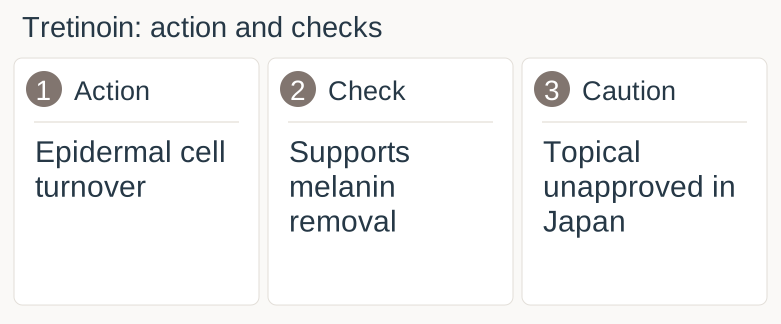
This topical medicine promotes skin turnover and helps remove accumulated melanin. It is often combined with hydroquinone and commonly causes redness or peeling early in use. The clinic’s publicly described topical formulation is explained as unapproved in Japan. Do not confuse approvals of oral and topical formulations.
Medical reviewer: Masashi Morita, MD
This topical medicine promotes skin turnover and helps remove accumulated melanin. It is often combined with hydroquinone and commonly causes redness or peeling early in use. The clinic’s publicly described topical formulation is explained as unapproved in Japan. Do not confuse approvals of oral and topical formulations.
- Ingredient
- Tretinoin (retinoic acid)
- Formulation covered
- Topical
- Main checks
- Topical approval status, skin condition and pregnancy
- Clinic publicly listed formulation
- 0.05%, 5 g
- Directions
- Follow the doctor’s instructions when prescribed
What tretinoin is and its effects
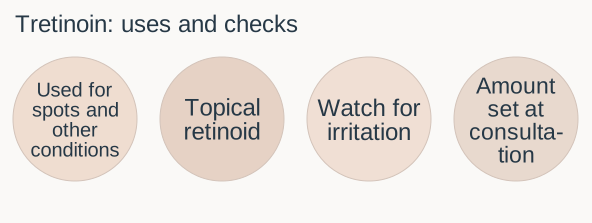
It is a topical medicine used for dark spots (age spots), post-inflammatory pigmentation, fine wrinkles and acne. It is a vitamin A derivative (retinoid) that promotes turnover of epidermal cells.
Melanin is gradually shed with epidermal cells. Tretinoin accelerates this turnover to help remove accumulated melanin.
While hydroquinone reduces production of new melanin, tretinoin helps remove existing melanin. Their different roles mean they may be combined.
Responses differ between individuals.
Differences from over-the-counter cosmetics
| Over-the-counter cosmetics | Clinic-prescribed product | |
|---|---|---|
| Ingredient | Vitamin A derivatives such as retinol | Tretinoin (retinoic acid) |
| Ingredient relationship | Converted to retinoic acid in the body to act | Retinoic acid itself |
| Status | Cosmetic | Clinic-listed topical formulation is unapproved in Japan; doctor assessment required |
| Monitoring | Self-assessed | Doctor assesses and adjusts amount and frequency |
Differences from hydroquinone and combined use
| What to check | Tretinoin | Hydroquinone |
|---|---|---|
| Ingredient | Tretinoin | Hydroquinone |
| Clinic public strength | 0.05%, 5 g | 5%, 5 g |
| Main role | Promotes epidermal turnover and melanin removal | Reduces new melanin production |
| Changes to watch | Redness, peeling, dryness, irritation | Redness, dermatitis, pigment abnormalities |
A doctor decides suitable medicines and combinations after checking skin status and history. Also see hydroquinone effects, directions and precautions.
Directions and application
Follow the doctor’s instructions for amount, frequency and area. Adjustments depend on skin response.
-
Do not spread over large areas or healthy skin
-
When combined with hydroquinone, apply tretinoin first
-
Use daytime sun protection during treatment
-
Amount, frequency and duration are decided during consultation
A doctor monitors skin response and adjusts amount, frequency and duration. Confirm breaks and restart timing during consultation.
Redness, peeling, dryness and stinging may appear approximately 2–3 days after starting. Severity and duration vary. Stop and seek advice for severe pain or swelling.
Treatment uses a period of application followed by a break. Progress depends on skin status; actual frequency and duration are decided during consultation.
When effects appear and how long they last
Redness and peeling may appear approximately 2–3 days after starting. Severity and duration vary between individuals.
Time until visible change varies. Have skin status and progress assessed, and discuss continuation or breaks with a doctor.
After a period of use, treatment takes a break and may restart while monitoring progress. Effects vary between individuals.
Main side effects
Common early changes (expected reactions) Redness, peeling, dryness and stinging. Severity and duration vary.
Changes requiring attention • Severe pain, swelling or blisters • Itchy eczema (dermatitis) • Darker pigmentation after use (post-inflammatory pigmentation)
Stop and contact the clinic for severe symptoms. Adjustment of amount or frequency, or a different treatment, may be proposed.
Ultraviolet exposure may increase irritation or pigmentation. Use sunscreen in every season during treatment.
When prescribing is not possible and precautions
When prescribing is not possible
The clinic cannot prescribe for the following people.
-
People who are pregnant, may be pregnant or wish to become pregnant
-
People who are breastfeeding
-
People with past hypersensitivity to an ingredient
-
People with eczema, sunburn, wounds or marked inflammation at the treatment site
Vitamin A derivatives are known to have potential effects on the fetus. Always disclose possible pregnancy during consultation.
Even without these conditions, skin status or other medicines may prevent prescribing.
Other precautions
-
Refrigerate and protect from light. Tretinoin breaks down readily with heat and light; room-temperature storage may reduce its effect
-
Each tube contains 5 g. Duration depends on application area. Aim to use within 1 month after opening. Do not use discolored product
-
If supplied as a hydroquinone set, tretinoin reaches its use limit first (hydroquinone has an approximate 3-month limit)
-
Only the prescribed person should use it. Transfer or sale to others is prohibited by law
-
Use sunscreen (SPF 20 or higher) daily during treatment, together with a parasol or hat
-
Keep out of children’s reach
General precautions
-
All clinic treatment is private care. Health insurance does not apply and costs are entirely out of pocket.
-
Every medicine can cause adverse reactions. A doctor checks history and other medicines and will not prescribe if safe use is not possible.
-
Prices include tax and may change without notice; confirm final costs during consultation.
Medicines requiring caution in combination
-
Peeling products or exfoliating cosmetics (salicylic acid, glycolic acid, scrubs and similar products) increase irritation when combined. Disclose use during the same period
-
Also disclose cosmetics or supplements containing vitamin A derivatives
-
Hair removal, laser treatment or Dermapen procedures may require a treatment break
The clinic asks about current cosmetics and skin care during consultation.
Important information about this medicine
Unapproved medicine in Japan
The clinic’s topical tretinoin has not received Japanese approval under the Pharmaceuticals and Medical Devices Act. It is prescribed as private care only when a doctor judges it medically necessary. Its formulation and indications differ from approved Japanese oral products.
How it is obtained
This is a preparation compounded within the clinic.
It is compounded and prescribed as private care only when a doctor judges it medically necessary. It is not an off-the-shelf product purchased for resale. The clinic manages preparation and storage.
Availability of approved medicines in Japan
No topical tretinoin formulation has Japanese approval under the Pharmaceuticals and Medical Devices Act.
Oral tretinoin (Vesanoid capsules) is approved in Japan for acute promyelocytic leukemia, but both its indication and dosage form differ from this preparation.
Overseas safety information
-
United States: the FDA has approved prescription topical tretinoin, used for many years for indications including acne vulgaris. It is also used as a prescription medicine in Europe.
-
Pregnancy: vitamin A derivatives may affect the fetus, and use during pregnancy is avoided in the countries described.
-
Early redness, peeling and irritation are commonly described in the countries’ product labels.
Because it is unapproved in Japan, efficacy and safety data in Japanese people are limited.
What you should understand
-
Unapproved medicines are not covered by Japan’s adverse-drug-reaction relief system. Harm is not eligible for relief under that system.
-
Compared with approved Japanese medicines, efficacy and safety data in Japanese people may be limited.
-
Receive a doctor’s explanation of use and possible adverse reactions, and follow the instructed amount, frequency and duration. Contact the clinic for concerning symptoms.
Consulting our clinic about a prescription
The clinic’s publicly listed topical tretinoin is 0.05%, 5 g, with a medicine price of JPY 2,980 including tax. Confirm amount, frequency, duration and hydroquinone combinations during consultation. For pricing, first consultation, questionnaire, booking and delivery, see the current tretinoin prescribing page. Skin status may require in-person examination or prevent prescribing.
Frequently asked questions
For Tretinoin cream, can redness or peeling occur when starting?
Yes. Redness, peeling and dryness may occur approximately 2–3 days after starting and are expected reactions to this medicine. Severity and duration vary. Stop and contact the clinic for severe pain, swelling or itchy eczema.
For Tretinoin cream, is combining it with hydroquinone preferable?
Their different roles mean they may be combined. Tretinoin helps remove accumulated melanin; hydroquinone reduces production of new melanin. Apply tretinoin first when combining them. The clinic also offers a two-medicine set. Discuss the appropriate combination during consultation.
Can I use tretinoin cream during pregnancy?
No. Vitamin A derivatives may affect the fetus. The clinic cannot prescribe for pregnant people, those who may be pregnant or wish to become pregnant, or those breastfeeding. Always disclose possible pregnancy during consultation.
For Tretinoin cream, how long until I can see an effect?
Time until visible change varies. Have skin status and progress assessed, and discuss continuation or breaks with a doctor.
Should I start with tretinoin cream or hydroquinone?
The two medicines are often combined because tretinoin helps remove accumulated melanin while hydroquinone reduces new production. However, early redness and peeling from tretinoin may lead to starting with hydroquinone depending on skin status. For prices and procedures, see tretinoin online care and prescription prices. Options are proposed during consultation.
Medical reviewer of this article
Dr Masashi Morita
Medical reviewer, Shimbashi Ginza Swift Clinic
- Board-certified specialist and instructor, Japanese Urological Association
- Board-certified specialist, Japan Endocrine Society
- Doctor of Medical Science, Showa University
- Graduate of Showa University School of Medicine
References
Book an online consultation for this medicine
Prescribing is decided after consultation. This link preselects the medicine consultation and the online visit method; it does not guarantee a prescription.